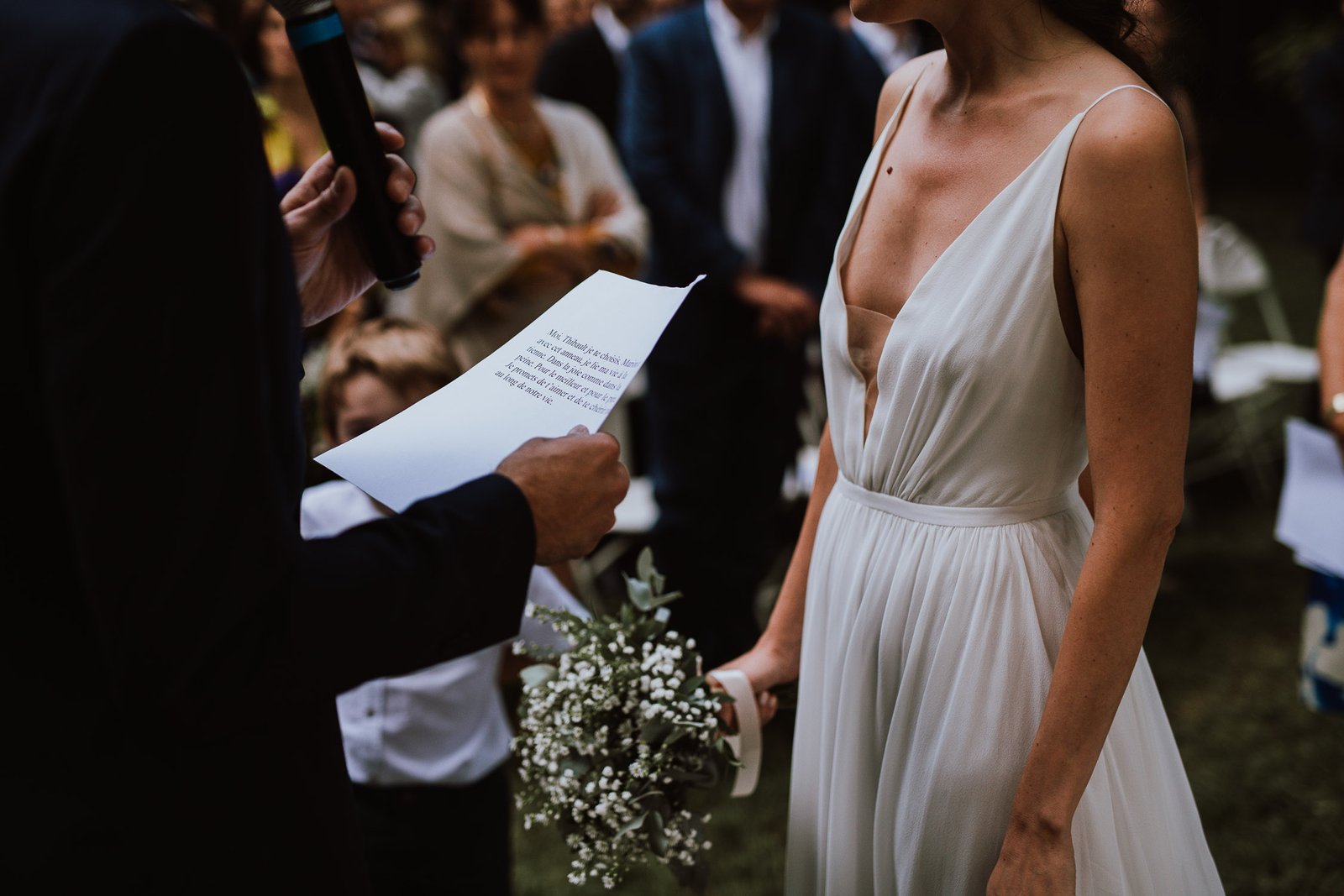
Non-Religious Wedding Ceremony: A Complete Guide to Meaningful Rituals and Ideas
A non-religious wedding ceremony can be just as emotional, meaningful and memorable as a traditional one.
For many couples, the challenge is not removing religion from the ceremony. It is finding the right structure, the right words, and the right rituals to create a moment that truly feels like them.
As a wedding photographer, I often see how powerful these ceremonies can be when they are simple, personal and well prepared. The right light, the right rhythm, a few sincere words, and the presence of your loved ones can create one of the most emotional moments of the day.
Here is how to plan a non-religious wedding ceremony that feels personal, fluid and sincere.
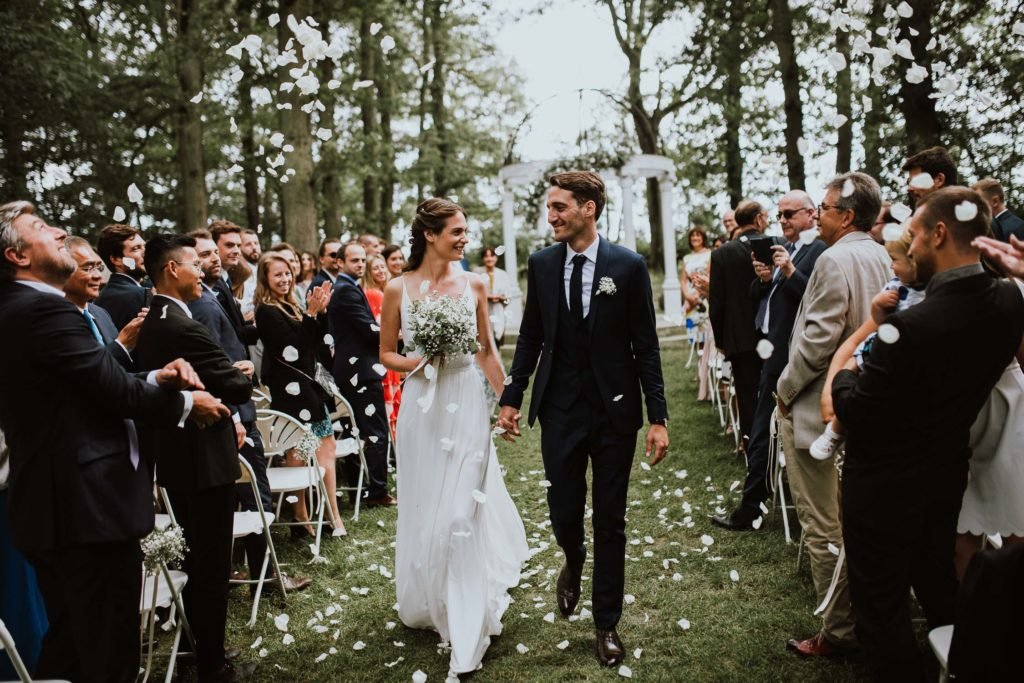
What is a non-religious wedding ceremony?
A non-religious wedding ceremony is a ceremony that celebrates your commitment without following a specific religious tradition.
It can still include vows, readings, music, symbolic rituals, family moments and a beautiful couple’s exit. The difference is that every part of the ceremony can be chosen freely, based on your story, your values and the atmosphere you want to create.
For many couples, this freedom is what makes the ceremony feel more personal. It allows them to build a moment that is intimate, sincere and truly connected to who they are.
Secular vs non-religious wedding ceremony: is there a difference?
In everyday wedding planning, the terms “secular ceremony” and “non-religious wedding ceremony” are often used in a very similar way.
A secular ceremony usually means that the ceremony is not connected to a religious institution. A non-religious ceremony simply means that the vows, readings and rituals do not include religious references.
In practice, most couples use both terms to describe the same intention: creating a ceremony that feels personal, meaningful and free from religious rules.
Why choose a secular ceremony?
What I love about secular ceremonies is how much space they give to what really matters: the human connection. No constraints, no imposed format — you can imagine almost anything. And that changes everything, not only for the couple, but also for the guests.
Total freedom
A secular ceremony is all about freedom. You decide the location, the structure, the tone, the readings, the people who take part… It’s a moment entirely shaped by and for you. You can write your own vows, invite loved ones to speak, include music that moves you — or all of the above. That’s what makes every ceremony so unique.
A more personal celebration
In the weddings I photograph, secular ceremonies are often the most emotional moments of the day. Because they’re made up of your words, your stories, your glances. It’s a powerful, sincere moment that truly reflects who you are. The guests feel it — and it’s often what they remember most from the day.
Less stress, more fluidity
Choosing to have only a secular ceremony (without going to city hall the same day) also means choosing simplicity. Everything happens in one place — no travel, no tight schedule to stick to. The couple is usually more relaxed, and it shifts the whole energy of the day. The logistics are smoother too, especially when the ceremony, cocktail and reception are all at the same venue.
Suitable for all types of couples
A secular ceremony is ideal if you don’t want a religious wedding, if you come from different cultural or faith backgrounds, or if you simply want a celebration that fully reflects who you are. It’s also a beautiful option for a second marriage, or for renewing your vows.
Indoors or outdoors, anything is possible
Many couples choose to have their secular ceremony outdoors, in a pretty garden, under an arch, or with a view they love. But it can just as easily take place indoors, in a warm and welcoming venue, if the weather or season calls for it. What matters most is that the space holds meaning for you.
The key steps to a successful secular ceremony
Since there are no fixed rules, every secular ceremony is different. But with a bit of structure and planning, it’s easy to create a moment that flows well, feels emotional, and reflects who you are. Here are the key steps to keep in mind.
1. Choose the right celebrant
This is the person who will set the tone. It can be a close friend or relative (a brother, sister, or friend) or a professional officiant. What matters most is that they’re comfortable speaking in public and able to tell your story with sincerity. The human connection is just as important as their experience.
2. Write or select the texts for the ceremony
You don’t need to write a novel — just create a structure to guide the moment. Usually, the celebrant will suggest a framework: an introduction, some transitions, and a closing. You can read through the texts together, or even co-write some parts. That’s what gives the ceremony real cohesion.
3. Prepare your vows
One of the most emotional moments of the ceremony. Each of you writes your vows in your own way, with your own words. Some keep it simple, others let the emotion speak. There’s no right or wrong — the only thing that matters is that it feels like you. And yes, tears (or laughter) are more than welcome.

4. Include one or more symbolic rituals
This is a beautiful way to add rhythm to your ceremony and create a memorable moment. We’ll go into more detail in the next section, but you can already start thinking about a ritual that feels meaningful to you: blending colored sand, tying ribbons around your hands, lighting a candle together… These small gestures can carry deep meaning.
5. Involve your loved ones
If some of your friends or family members would like to read something, share a story, or say a few words, this is the perfect time. Usually, two or three speeches are more than enough. Better a few short, heartfelt messages than too many that weigh down the moment.
6. Choose the music
Music enhances emotion. You can plan one song for the couple’s entrance, another during a ritual, and a final one for the exit. Whether it’s live or on a playlist, it doesn’t matter — as long as the songs resonate with you.
7. Set the scene and care for the details
A secular ceremony outdoors, under a flower-covered arch with neatly arranged chairs, instantly sets the mood. Indoors, lighting and thoughtful decoration also play a big role. Don’t forget the practical side: microphone, sound system, seating for your guests… These small touches make the whole experience more enjoyable for everyone.
8. Do a quick run-through (and don’t forget… the couple’s exit!)
No need to rehearse every second. But a short briefing the day before or on the morning of the wedding with your celebrant and the key participants can help avoid any surprises. Most importantly, leave room for spontaneity. Those little unplanned moments often make for the best memories.
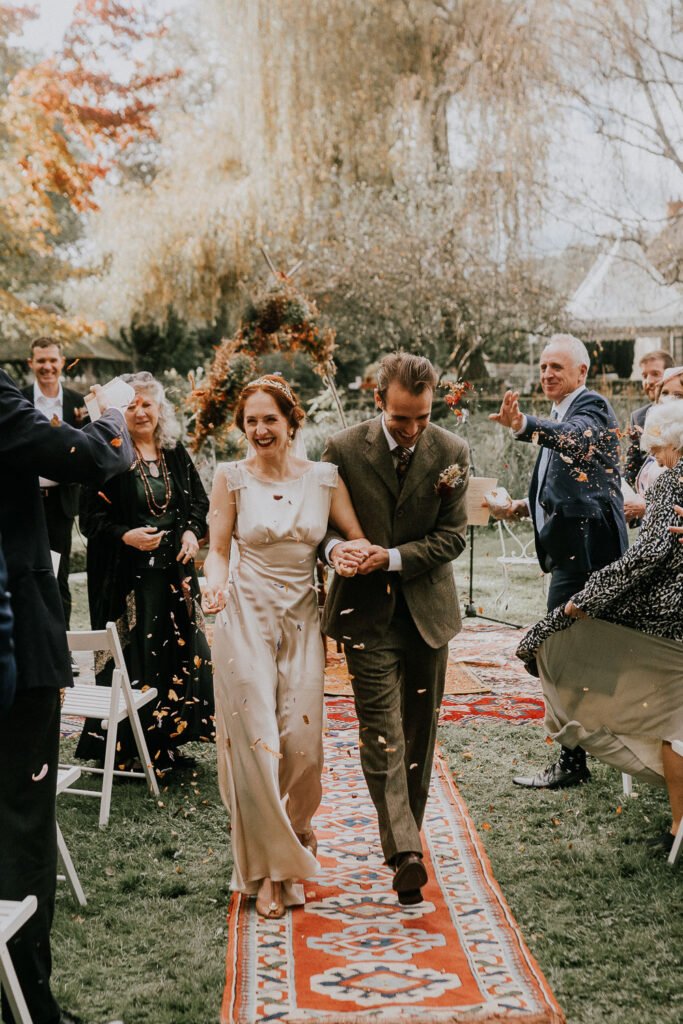
And above all… don’t skip planning your exit! It’s often one of the happiest and most photogenic moments of the ceremony. Guests rise, applaud, toss flower petals, blow bubbles… The energy is incredible, and everyone is smiling. It’s a real celebration — and as a photographer, it’s one of my favorite scenes to capture. So it’s definitely worth taking a few minutes to plan for it, and enjoy it to the fullest.
Simple non-religious wedding ceremony structure
A non-religious ceremony does not need to be complicated. A clear structure often helps everyone feel more comfortable.
Here is a simple flow you can adapt:
- Guests arrive and take their seats
- The couple enters
- The celebrant welcomes everyone
- A short introduction about the couple’s story
- One or two readings from loved ones
- Personal vows
- A symbolic ritual
- Exchange of rings
- Final words from the celebrant
- The couple’s exit
The goal is not to make the ceremony long. The goal is to give it rhythm, emotion and a natural flow.
🌿 6 Symbolic Ritual Ideas for a Meaningful Secular Ceremony
Symbolic rituals bring an even more personal dimension to a secular ceremony. They help mark a powerful moment, create a shared memory, and sometimes even involve your loved ones. Here are some original secular ceremony ideasI’ve had the chance to witness during my wedding reportages.
1. The Sand Ceremony
This is one of the most common rituals, but still a very powerful one. Each partner pours colored sand into a single container. The blending of the sand symbolizes the union of your lives, your stories, and your roots. It’s simple, visual, and it always works beautifully.
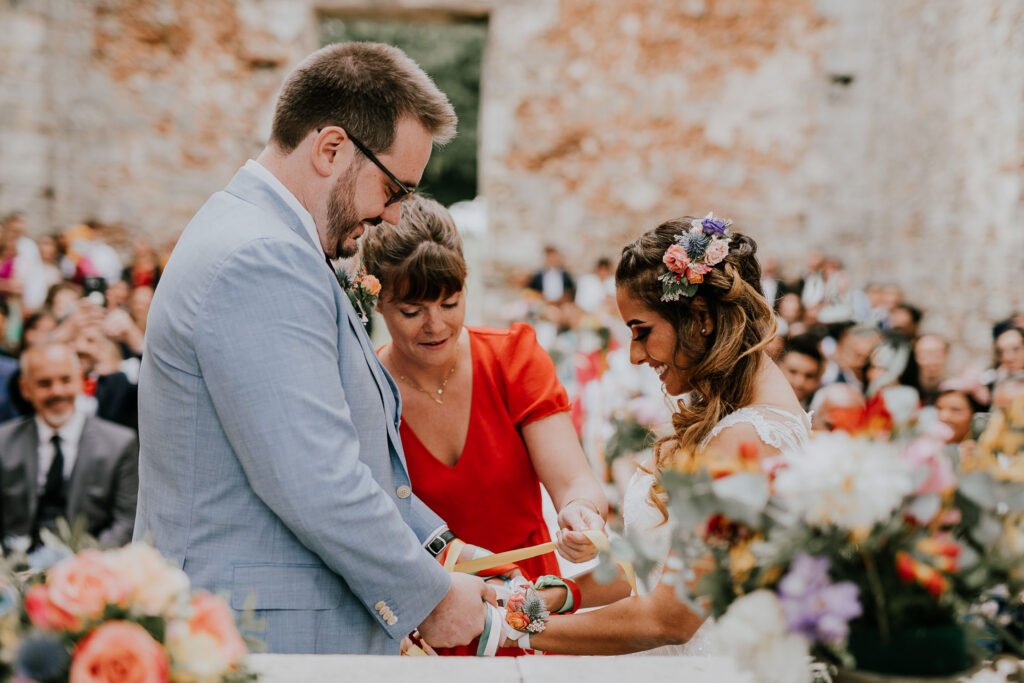
2. The Ribbon Ritual (or Handfasting)
This ancient Celtic ritual involves tying ribbons around the couple’s hands, usually in a symbolic knot. Each ribbon can represent a meaningful value for the couple — love, trust, fidelity… It’s a moment that’s both visually striking and deeply symbolic, often used in outdoor secular ceremonies. The gesture is simple, but full of meaning: it represents unity and commitment in its purest form.
3. A Nature-Inspired Ritual
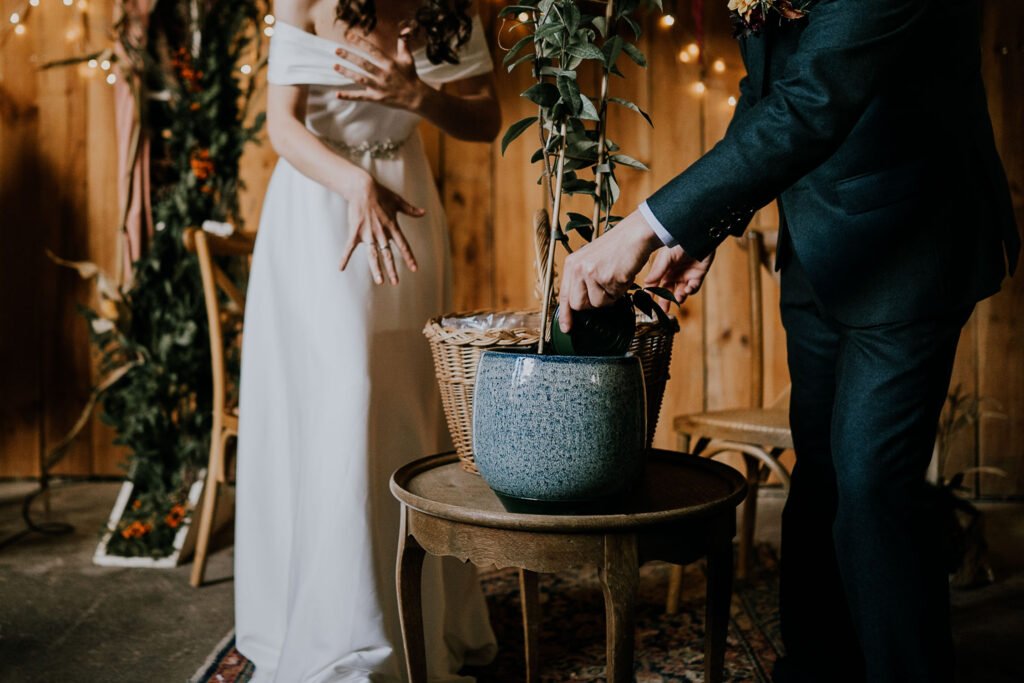
For couples who feel deeply connected to nature, certain rituals can take on a beautifully symbolic meaning. I once saw an English bride bring soil from her hometown, while her groom brought a plant he cared about. Together, they blended them during the ceremony.
On another occasion, the couple actually planted a tree on the family estate, just after saying “I do.” It was such a powerful moment — the land belonged to the groom’s uncle, and the tree would grow there as a living witness to their union.
4. The Wishing Tree
Another nature-based ritual — but this time with the guests involved. Each person writes a short note, a wish, or a message, and then hangs it on a wishing tree set up near the ceremony. It’s both beautiful and emotional, with a poetic touch — and the couple leaves with a precious collection of memories.
5. Collective Art
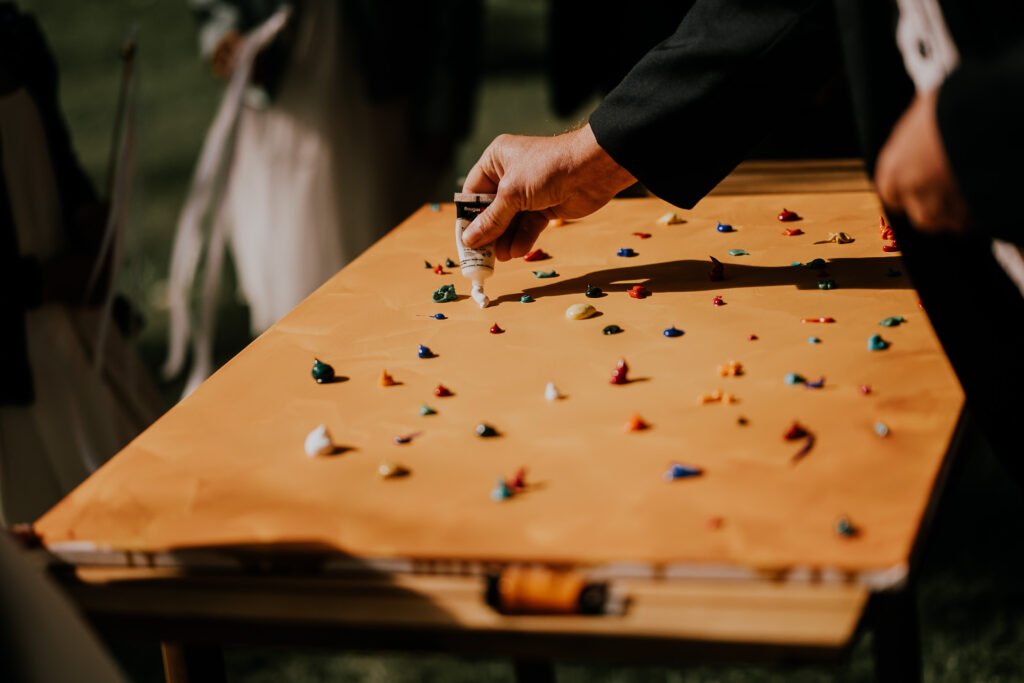
More original, but just as impactful: the collective art ritual. At one wedding, each guest added a small brushstroke to a canvas using the color of their choice. Then the bride used a squeegee to create an abstract painting out of all those colors. The final result was unique — a true reflection of their day and the people who shared it with them.
6. The Sealed Memory Box
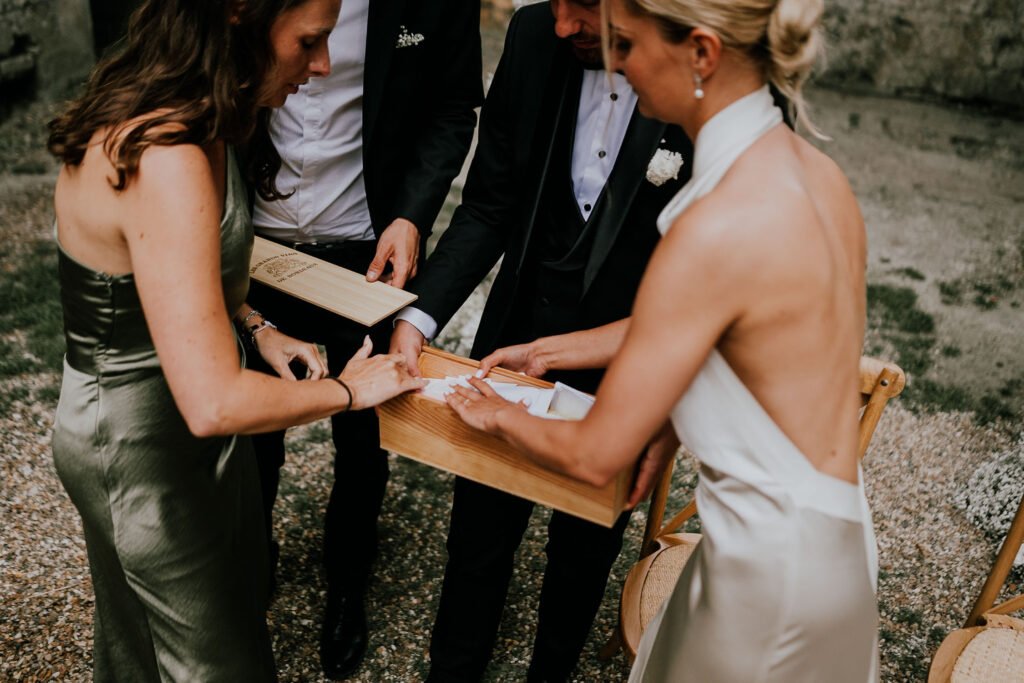
This ritual involves the couple’s closest friends or witnesses. I’ve seen couples place a bottle of wine and personal letters into a wooden box, which they then sealed together with their witnesses. The idea? To open it all together in 10 years. It’s a powerful gesture — one that invites you to look ahead, to reunite, and to celebrate your love once again… in a whole new way.
📸 Photographer’s Tips for a Successful Secular Ceremony
As a photographer, I experience the ceremony with a slightly different perspective — I’m there to capture the emotion, the light, and the little spontaneous gestures. And over time, I’ve picked up on a few details that can really make a difference — for you, and for the way your memories are preserved in photos.
Pay attention to the light
If you’re planning an outdoor secular ceremony, be mindful of the direction of the arch or the ceremony space. Harsh sunlight can be uncomfortable (and not very flattering in photos). The ideal setting? Soft, golden light — like late afternoon — with a bit of natural shade if possible.
Use a microphone, even with a small group
People often think, “we’re just among close friends, we don’t need a mic.” But even in a small setting, wind, birds, or emotion can make it hard to hear the words. And if guests can hear everything clearly… they feel more connected to the moment. And I can capture more genuine reactions.
Create a setting that reflects you
An arch, a few flowers, two or three well-chosen elements — that’s often enough to set the tone. It’s not about budget, it’s about choosing something that matches your style. Visually, a thoughtful backdrop immediately adds depth and emotion to your photos.
Be yourselves
This might be the most important tip: don’t try to be “perfect.” Let the emotions flow — laugh if you feel like it, tremble a little if you’re nervous. These real, honest moments are my favorites to photograph — the ones where you’re truly living the moment.
Don’t forget the couple’s exit
As I mentioned earlier, this is often one of the most joyful — and photogenic — parts of the ceremony. Guests stand, applaud, toss petals, blow bubbles… so much happens in just a few seconds, and it’s pure joy. Think through this little moment in advance so it unfolds smoothly — and trust me, the photos will be worth it.
If you are planning your ceremony in France, you may also find it helpful to read my guide on planning a destination wedding in France, or to explore a few wedding venues near Paris where an outdoor ceremony can feel natural and intimate.
And if photography is an important part of the way you want to remember this moment, you can also have a look at my wedding photography portfolio or tell me more about your wedding ceremony.
FAQ about non-religious wedding ceremonies
Can you have a wedding ceremony without religion?
Yes. A wedding ceremony can be meaningful without being religious. You can include vows, readings, symbolic rituals, music and personal speeches without referring to a specific religious tradition.
Who can officiate a non-religious wedding ceremony?
It depends on the country and the legal context. In many cases, the legal marriage is done separately at the city hall, and the non-religious ceremony is led by a professional celebrant, a friend or a family member.
What do you say in a non-religious wedding ceremony?
You can include a welcome speech, a few words about your story, readings, personal vows, symbolic rituals and a final declaration. The most important thing is that the words feel sincere and natural.
How long should a non-religious wedding ceremony last?
Most non-religious wedding ceremonies last between 20 and 40 minutes. Shorter ceremonies can feel intimate and fluid, while longer ones need a clear rhythm to keep guests emotionally present.
What are meaningful non-religious wedding rituals?
Popular non-religious rituals include the sand ceremony, handfasting, a wine box ceremony, a wishing tree, collective art, or planting a tree. The best ritual is the one that feels connected to your story, not the most spectacular one.
In Summary
Planning a secular ceremony means giving yourself the freedom to experience a truly personal moment — one that’s entirely shaped by your story. No imposed rules, no formal obligations: just emotion, meaning, and a beautiful dose of personalization.
Whether it’s simple or filled with rituals, outdoors under a big tree or indoors in a cozy venue, what matters most is that it reflects who you are. And it’s often these sincere, slow-paced moments that stay with you the longest — both in your heart and in your photos.